
St. Johns County Court Records After a Jail Arrest
After an arrest in St. Johns County, the jail creates a booking record, but the court record begins later. The State Attorney for the Seventh Judicial Circuit reviews the arrest and decides what to file. When charges are filed, a case opens with the St. Johns County Clerk of the Circuit Court, and that case file is the court record people search. The Clerk's criminal division handles felony, misdemeanor, criminal traffic, county ordinance, and municipal ordinance cases, which is why one name can produce several different criminal case types.
It helps to keep the two sides apart. The booking and custody side lives on the jail roster, covered in St. Johns County jail inmate records, and booking photos sit on St. Johns County jail mugshots. The court record after an arrest is separate. It tracks the charges the prosecutor filed, the hearings, and the disposition. The booking charge at the jail and the charge a prosecutor finally files are not always the same.
How to Find St. Johns County Court Records After an Arrest
The court record search runs through the Clerk's Benchmark Court Records Search. It lets the public search by name, case number, citation number, or date, and filter by court type. The Clerk describes its online court search as real time, which is different from the jail roster. The arrest and booking detail still lives on the roster, not in the court index.
- Open the Clerk's Benchmark Court Records Search.
- Search by the defendant's name, or by case or citation number if you have one.
- Filter by a criminal court type such as Criminal Felony or Misdemeanor to narrow results.
- Open the case to read the charges, events, court dates, and the current status of each charge.
If the person was just arrested, wait for first appearance or formal filing, since a brand-new case may not show a charge list yet. For a complete statewide criminal history, the Florida Department of Law Enforcement runs a public check for a $24 fee, which is separate from a single court case search.
The St. Johns County Clerk's criminal division page explains the case types it handles and links the court records search and copy fees.
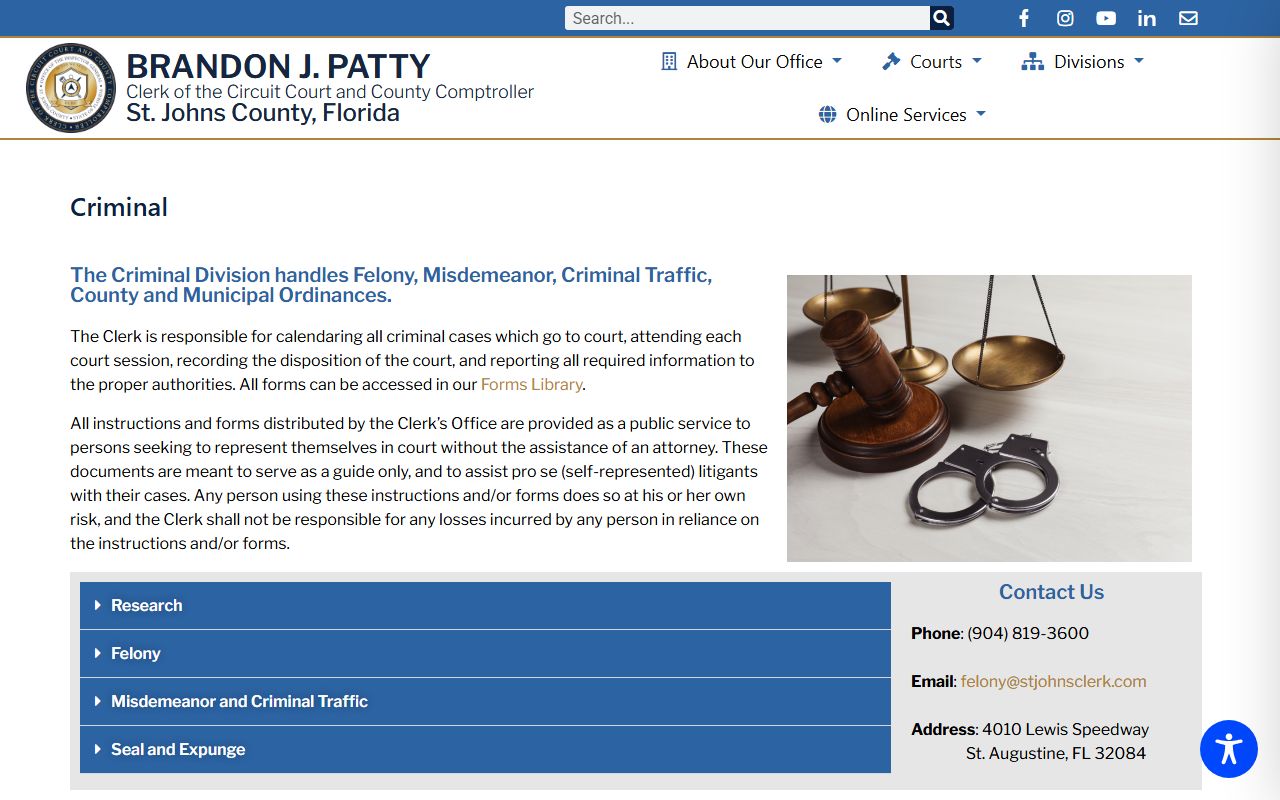
That page is the gateway to the case files that follow a St. Johns County arrest.
Court Records Search Fields
The Benchmark search accepts more than a name. The captured field set lets you narrow a search by date, court type, and party role, which matters when a common name returns many cases. The portal needs JavaScript and shows best on a wider screen.
| Field Label | Type | Notes |
|---|---|---|
| Name | Text | Party or defendant name search. |
| Case Number | Text | Local or uniform case number. |
| Citation Number | Text | Traffic or criminal citation lookup. |
| Date Opened / Closed | Date range | From and To fields. |
| Court Types | List | Criminal Felony, Misdemeanor, Criminal Traffic, county and municipal ordinance, and more. |
| Party Types | List | Plaintiff, Defendant, Judge, Attorney, include alias. |
How Charges Get Filed After an Arrest: Complaint, Information, and Indictment
The court record after an arrest starts with a charging document. Booking happens first at the jail, then the prosecutor decides whether to file and how. In Florida the prosecutor is the State Attorney, not a district attorney. Most felonies are filed by an information, serious felonies may go to a grand jury for an indictment, and lesser matters often begin with a complaint or citation. Each one opens a case in the Clerk's system.
| Complaint | Information | Indictment | |
|---|---|---|---|
| Filed By | Officer or prosecutor | State Attorney | Grand jury |
| Common For | Misdemeanors and citations | Many felonies | Serious felonies |
| Starts the Case | Yes | Yes | Yes |
Charge Status After an Arrest and What It Means
Charges shift as a case moves. The State Attorney can amend, reduce, add, or drop charges, so the booking charge on the jail roster can differ from what the court record finally shows. Reading the status on each charge is the only way to know where a case stands. The terms below are the common ones in a Florida criminal case.
| Status | What It Means |
|---|---|
| Pending | The charge is filed and the case is still moving through court. |
| Amended or Reduced | The prosecutor changed the charge, often to a lesser offense. |
| Dismissed | The court or prosecutor ended the charge without a conviction. |
| Nolle Prosequi | The prosecutor formally declined or dropped the charge. |
| Adjudication Withheld | The court withheld a formal conviction after a plea or finding. |
Note: A booking charge listed at the jail is the arresting officer's charge and may not match the charge the State Attorney later files in the court record.
Bond and Release After an Arrest
Bond is usually addressed at first appearance, the early hearing where a judge reviews custody. The Sheriff routes bond questions to the booking line at 904-209-3125 and warns about scammers who pose as bondsmen, use online inmate data to reach families, and ask for app payments. Legitimate bond companies use traditional payment and established channels. A cash bond paid by money order must be verified before the bond is processed.
| Bond Type | How It Works |
|---|---|
| Cash Bond | The full amount is posted in cash with the court or jail. |
| Surety Bond | A licensed bond company posts the bond for a fee. |
| Release on Recognizance | Release on conditions set by the court, without a cash deposit. |
| No-Bond Hold | The court or a hold keeps the person in custody until a judge changes it. |
Even after a local bond is posted, a person can stay in custody because of a detainer, a warrant from another county, or a federal or immigration hold.
Warrants That Lead to an Arrest
An outstanding warrant can lead straight to a booking. The Sheriff offers a wanted and warrant search and a Court Services warrant line at 904-209-1440. The Florida Department of Law Enforcement runs a statewide Wanted Persons search, and it warns the public to verify any warrant with the reporting agency and not to act alone. The Clerk, by contrast, does not publish active warrant information.
Under Florida court rules, a warrant and its supporting affidavit stay confidential until served or until an agency decides the warrant cannot be carried out. Once a return of service is filed, the warrant and affidavit may become viewable inside the related court case. A person who appears in person while a warrant is active can be arrested, so contacting an attorney first is wise.
Charges vs. Convictions in the Court Record
An arrest and a filed charge are accusations, not proof of guilt. The Sheriff states plainly that people on the inmate pages have been arrested but not found guilty. A conviction requires a plea or a verdict held to a much higher standard.
| Charge | Conviction | |
|---|---|---|
| Stage | Accusation after arrest | Plea or verdict |
| Burden of Proof | Probable cause | Beyond a reasonable doubt |
| Public Record | Yes | Yes |
Sealed vs. Expunged Records After an Arrest
Florida lets some people clear an arrest record after a dismissal or an eligible outcome. Sealing hides a record from general public view, while expunction goes further and treats the record as removed. The Clerk lists fees tied to the process, including a state fee paid to the Florida Department of Law Enforcement, a clerk processing fee, and small notary and fingerprint costs. State law also provides automatic sealing for some dismissed cases after the state agency gives notice.
| Sealed | Expunged | |
|---|---|---|
| Visibility | Hidden from public view | Treated as removed |
| Law Enforcement | Limited access | Very limited access |
| Eligibility | Qualifying outcomes under Florida law | Narrower, often dismissed or dropped cases |
Background Check Considerations
A single court case search is not a background check. A casual lookup can miss amended charges, sealed cases, or matters in another county. A formal background check for hiring or housing is governed by federal law and must use a compliant process and a consumer reporting agency.
Important: This site is not a consumer reporting agency under the FCRA, and its content may not be used to decide employment, housing, credit, or insurance.
Restricted Court Records After an Arrest in St. Johns County
Some court records after an arrest are limited. Juvenile cases are not public like adult cases. Sealed and expunged matters drop from public view, and a dismissed case can become confidential after the state agency notifies the Clerk. Warrants and affidavits stay confidential until served. For older or hard-to-find cases, the Clerk offers a Request for Criminal Research, with a $2 search fee when no case number is given, $1 per page for copies, and $2 for certification, usually answered by email in a few business days.
The State Attorney's local office handles the prosecution side of these cases. A look at its St. Augustine office page shows where that office sits in the Lewis Speedway complex.
The Office of the State Attorney, Seventh Judicial Circuit, lists its St. Augustine office for the prosecutor who files charges after a county arrest.
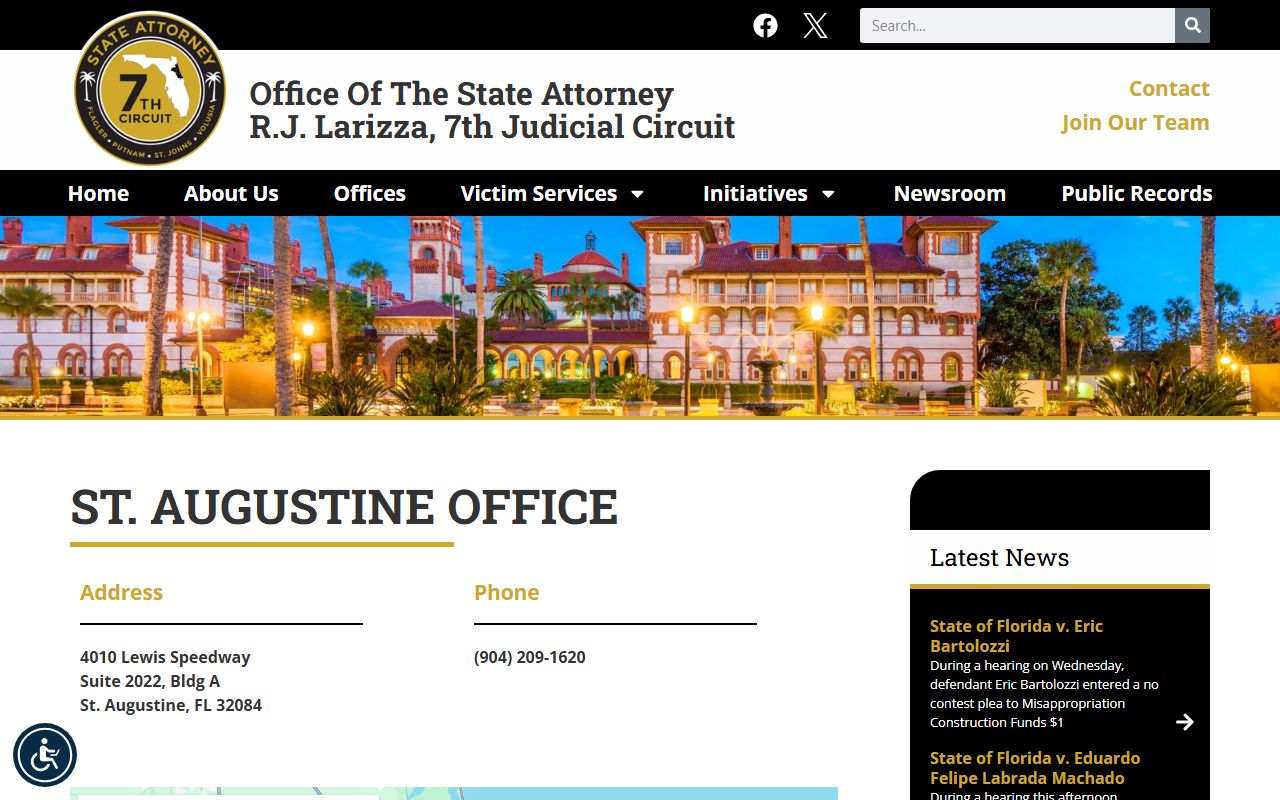
State Attorney R.J. Larizza leads that office, which reviews arrests and files or declines the charges that form the court record.